On the strange science of memory, the wisdom of rest, and what a German psychologist figured out in 1885 that most classrooms still haven’t caught up with
Dr Arun Prakash
Rohan could explain photosynthesis perfectly on Monday. By Friday, much of it had vanished. Three weeks later, almost all of it was gone.
He was one of those students who did everything right. Front row. Notes in two colours — blue for main points, red for definitions. Studied the night before every test, sometimes until midnight. Could recite the water cycle, the causes of the First World War, all of it, word for word, the morning of the exam.
And a few weeks later, he remembered almost none of it.
He was not careless. Not lazy. He was, in the way most of our children are, genuinely trying.
But nobody had ever told him how memory actually works.
Nobody had told his teachers either, I suspect.
I have spent over forty years in classrooms, and I have said this to myself more times than I can count:
We teach children what to learn.
We almost never teach them how to learn.
I remember a staff meeting — must have been sometime in the late 1990s, I cannot pin the year exactly — where a young teacher, bright fellow, came to me with a problem. His students were scoring well in class tests, he said. But by the time the half-yearly came around, they seemed to have forgotten everything. He was frustrated. He thought he was failing them.
I did not have a good answer for him at the time. I said something about revision, about going over old material. Standard advice. The kind of thing you say when you are not really sure.
It bothered me for years, that conversation. Because he was right. Something was going wrong. And I did not fully understand what.
I understand it better now.
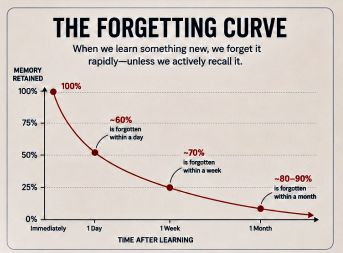
In 1885, a German psychologist named Hermann Ebbinghaus sat alone in a room and did something rather unusual. He spent months memorising lists of nonsense syllables — meaningless combinations like “DAX” and “BUP” — and then tested himself at different intervals to see how much he retained.
What he discovered became one of the most influential findings in the science of learning.
He called it the Forgetting Curve.
Ebbinghaus found that forgetting happens surprisingly quickly. Much of what we learn begins to fade within hours if it is never revisited. Within days, a large portion may be gone. Within weeks, only fragments often remain.
This is not a failure of intelligence. It is simply how the human brain is built.
The brain is not a hard drive. It is more like — and I have tried many analogies over the years, none of them perfect — a crowded market. Noisy. Constantly deciding what deserves space on the shelf and what gets quietly moved to the back. Information that is used repeatedly stays. Information that arrives once, on the night before an exam, and is never revisited, fades.
Rohan was not forgetting because he was not trying hard enough.
He was forgetting because he was studying in exactly the way that guarantees forgetting.
After more than a century of research, we know a great deal about how learning actually sticks. Modern research on memory, spaced repetition, retrieval practice and the role of sleep continues to confirm what Ebbinghaus first observed more than a century ago. Three ideas stand out. The surprising thing is how simple they are.
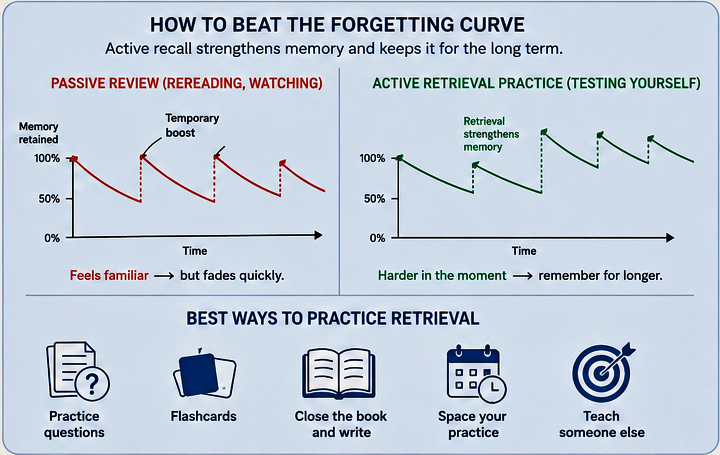
The first is called spaced repetition.
Instead of studying everything the night before a test, spread the learning out. Review something today. Then again in two days. Then again in a week. Then a few weeks later.
Each time you return to an idea before you have completely forgotten it, you strengthen the neural pathway associated with it. The brain’s equivalent of a path that becomes easier to walk every time it is used.
I once explained this to a Class IX group — a particularly restless lot, as I recall, very hard to hold — using an image from their own lives.
Learning, I told them, is like watering a plant. You do not pour three weeks’ worth of water onto it on a Sunday evening and then ignore it until the end of the month. You return regularly. A little attention, repeated over time, is what allows something to grow.
They went quiet for a moment. Then one boy in the back — the kind who usually has a comment for everything — said, “Sir, then why do we study this way?”
I did not have a clean answer for him. I still do not, fully.
The second principle is called retrieval practice — or, in simpler language, testing yourself.
There is a significant difference between reading your notes and trying to recall what is in them without looking.
Reading feels productive. The information is on the page. It looks familiar. And familiarity creates the comforting illusion that we know something.
I suspect this problem has become even more common in recent years.
Many students today do not spend their evenings with textbooks and notebooks. They spend them with online classes, recorded lectures and YouTube tutorials. There is nothing wrong with these resources. Some of them are excellent. In fact, some teachers explain certain concepts far better than many textbooks ever could.
The difficulty is that students often mistake watching for learning.
I meet children who spend three or four hours watching one video after another. They lie comfortably on a bed, a packet of chips nearby, a cold drink within reach, headphones on, listening to somebody explain mathematics, science or history. By the end of the evening, they genuinely feel they have worked very hard.
And in a sense, they have. They have invested time.
What they have not necessarily done is learn.
Many students today confuse exposure with learning.
Watching a teacher solve ten problems is not the same as solving one yourself. Listening to an explanation is not the same as retrieving it from memory later. Understanding something while a video is playing is not the same as being able to explain it tomorrow without help.
Sometimes a student tells me, “Sir, I watched four hours of lectures.”
My first question is usually, “How many pages did you write?”
The answer is often uncomfortable.
Because memory is built through engagement, not simply exposure. Notes, summaries, self-testing, solving problems, explaining ideas to someone else — these activities force the brain to work. Watching alone often allows the brain to remain a spectator.
The technology is new.
The underlying science is not.
The brain still learns much as it always has.
But when you close the book and try to pull the information from memory — that effort, that slight struggle — that is what actually builds the memory. The act of trying to remember is itself part of the learning.
Teachers who begin class by asking students what they remember from yesterday’s lesson are doing something powerful. Parents who ask at dinner, “Tell me one interesting thing you learned today” — they are doing it too, whether they know the term or not.
The third principle is perhaps the most surprising.
Sleep.
During deep sleep, the brain replays and consolidates the experiences of the day. Memories are strengthened. Connections are formed. New information finds its place within what is already known.
A child who studies until midnight and wakes up exhausted is not merely losing rest. In a biological sense, that child may also be shortening the very process that helps learning become permanent.
The student who studies sensibly and then sleeps seven or eight hours will often outperform the one who pushed through until two in the morning. Not because sleep replaces effort. Because sleep is part of effort.
There is another uncomfortable truth here.
Much of schooling still rewards short-term performance more than long-term retention. If a student reproduces information on Friday’s test, we assume the learning has happened. Whether that knowledge survives until next month is rarely measured.
What gets measured gets valued. And what gets valued shapes how students study.
That young teacher who came to me in the late nineties — he was noticing exactly this. His students were performing. They were not retaining. And the system had no language for that difference.
I think of Rohan sometimes.
He was working hard in the way he had been shown. The problem was never his commitment. It was the method. And the method had gone unquestioned because everyone around him had inherited it from someone else. His teachers taught as they had been taught. His parents advised as they had been advised.
None of this was anyone’s fault, really.
But it is something we can change.
If I could sit beside Rohan for ten minutes before his next examination season, I would not tell him to study more. I would tell him to study differently. Review what you learned today. Return to it tomorrow. Close the book and test yourself. Sleep properly. Trust the process.
I would tell him that his brain is not betraying him.
It is doing exactly what it was designed to do.
And once we understand that, we can begin working with it rather than against it.
The Forgetting Curve is real.
But so is its opposite — learning that lasts.
Not built through a single anxious night. Not built through panic and cramming. But through the patient habit of returning. Again and again. With time, with rest, with purpose.
The tragedy is not that students forget. Forgetting is normal.
The tragedy is that after more than a century of understanding how memory works, many children still spend their school years being taught subjects without ever being taught how to remember them.
That may be one of the most important things schools still need to teach.