Dr Arun Prakash, Editor-in-Chief
The images were hard to miss—warm smiles, gracious hospitality, cultural elegance, and an unmistakable ease as Malaysia welcomed India’s Prime Minister, Narendra Modi, and Malaysia’s Prime Minister, Anwar Ibrahim. It was not the loud welcome of muscle-flexing diplomacy, but something subtler and more confident. A nation comfortable with itself does not need to raise its voice. As the visit unfolded, many of us found ourselves wondering—not about agreements or protocols, but about Malaysia itself. A country that balances tradition and modernity so effortlessly. A nation that has Sultans and a King, yet functions as a stable, thriving democracy. A society that may debate loudly at times, but rarely slips into chaos—and quietly keeps moving forward.
That curiosity leads to a deeper question: how does a country with royal houses avoid the excesses of royalty, and how does it preserve crowns without surrendering power to them?
The answer lies not in personalities, but in how power is taught to behave.
When Crowns Forget Their Limits
Across history and even in the present world, monarchies have taken many forms. In absolute monarchies—where power flows unchecked from throne to subject—the state often becomes inseparable from the ruling family. Authority is inherited, accountability limited, and dissent uncomfortable at best, dangerous at worst.
In such systems, luxury itself becomes a language of power. Palaces glitter with gold, private aircraft resemble flying mansions, and everyday objects are transformed into symbols of excess—sometimes even adorned with precious metals. Wealth is displayed not merely as prosperity, but as dominance. Yet beneath this shine, civic rights remain narrow, institutions weak, and modern civil society carefully contained.
Stability in these systems may look imposing, but it is often sustained by control rather than consent. When power grows faster than institutions, grandeur expands while accountability shrinks.
This is not a judgement of cultures or peoples, but a simple observation of structure. Where power answers only to lineage, restraint relies on personal wisdom—and history has repeatedly shown that wisdom does not reliably pass through bloodlines.
Monarchy Without Power—and With Privilege
At the other end of the spectrum stand constitutional monarchies where kings and queens no longer rule, yet remain highly visible. Britain is the most familiar example, joined by countries such as Japan, Sweden, Norway, Denmark, and the Netherlands. In these nations, governance rests firmly with elected governments, but royal institutions continue to command enormous public attention.
Here, monarchy survives largely as spectacle and symbolism. Grand ceremonies, lavish residences, extensive security, and publicly funded privileges are accepted as the price of continuity and tradition. Royal families live lives of visible luxury—celebrated, scrutinised, occasionally questioned, but rarely altered. Their authority may be ceremonial, yet their presence is constant and costly.
The crown in these systems does not steer the nation, but it undeniably occupies centre stage. It adds colour, pageantry, and emotional continuity, even when its contribution to governance remains symbolic. This model works for societies that accept the trade-off: no political power, but considerable privilege.
Malaysia, however, quietly refuses both excess and spectacle.
A Different Malaysian Choice
The Man Behind the Crown
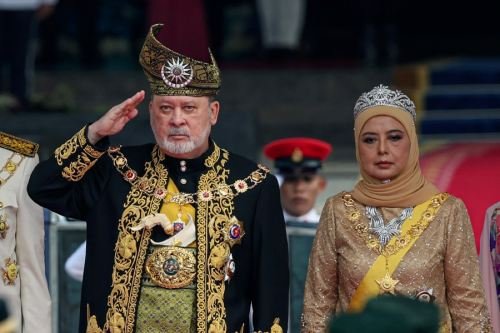
Educated in Malaysia and abroad, and formally trained in the military, Sultan Ibrahim represents a blend of tradition and modern exposure. He is supported by Her Majesty Raja Zarith Sofiah, the Queen of Malaysia—widely respected for her intellect, cultural engagement, and quiet public presence—together forming a royal household that values family, discipline, and public duty.
Away from ceremony, the King is known for a hands-on temperament and an unusual personal interest in transport and infrastructure, often inspecting projects firsthand. As monarch, his role remains constitutional and ceremonial, yet his presence reflects the Malaysian ideal of monarchy—dignified, restrained, visible, and firmly within the bounds of law. Picture Credit : BERNAMA
Malaysia’s monarchy neither dominates governance nor overwhelms public life. It operates within boundaries—clear, constitutional, and deliberately enforced.
The country has nine hereditary Sultans, each heading a state and serving as custodians of Malay tradition and Islam. From among them, one is elected every five years as the Yang di-Pertuan Agong—the King of Malaysia. This rotating monarchy itself sends a profound message: even the highest crown is temporary, chosen from among the Sultans in an agreed order of seniority determined by their dates of accession, and held only for a fixed five-year term.
What is often less known is that Malaysia is not uniformly royal. Four states—Penang, Malacca, Sabah, and Sarawak—do not have Sultans at all. They are headed by Governors appointed through constitutional processes. Tradition is respected where it exists, but governance does not depend on it. The system adapts without anxiety.
Equally significant is restraint in privilege. The allowances, roles, conduct, and public behaviour of the Sultans and the King are constitutionally defined. Displays of wealth are regulated. Authority is symbolic, not discretionary. Over time, even royal immunities have been consciously narrowed, reinforcing a powerful principle: dignity does not place anyone above the law.
This is monarchy with discipline—not because rulers are saints, but because the system expects restraint.
Where Power Actually Resides
In Malaysia, governing authority belongs unmistakably to elected institutions. The Prime Minister, Parliament, judiciary, and civil services exercise real power. Governments rise and fall. Coalitions shift. Courts function. Politics can be noisy—but the framework holds.
This separation matters. When political power is clearly civilian and accountability institutional, the state does not shake with every disagreement. Businesses invest with confidence. Citizens plan futures. Diversity becomes manageable, not threatening.
Stability here is not the absence of debate. It is the presence of limits.
A Shared Understanding, Not a Lecture
India’s engagement with Malaysia in recent times has drawn attention beyond trade and diplomacy. It reflects the confidence of a nation that understands governance, values institutions, and engages the world from a position of strength. India’s democratic framework—robust, argumentative, and deeply rooted—has endured scale, diversity, and history that few nations can match.
Crucially, India’s governance operates firmly within the supremacy of its Constitution. The strength of the present system lies not in personalities, but in institutions—an elected government functioning through constitutional authority, judicial independence, and parliamentary accountability. That alignment between leadership and law is precisely why India projects confidence, not uncertainty.
That strength is visible not merely in electoral processes, but in outcomes. Expanding infrastructure, a growing manufacturing base, rising military capability, technological ambition, and a renewed sense of national pride mark a country that knows where it is headed. Governance, in such a system, is not just administrative—it is purposeful and aspirational.
Malaysia’s experience does not challenge this story; it complements it. It reinforces a shared truth that both nations demonstrate in their own ways: societies prosper when power respects boundaries and institutions outlast individuals.
The Wisdom of Knowing Where Power Belongs
In Malaysia, crowns bow to constitutions. In India, constitutions empower the people through their elected representatives. The histories are different, the structures distinct—but the underlying philosophy is strikingly similar. Enduring nations are not built on spectacle, but on systems. Not on unchecked authority, but on disciplined power exercised through law.
Tradition need not obstruct democracy. Leadership need not overpower institutions. Prosperity grows where governance is stable, law is predictable, and authority is exercised with constitutional restraint.
Perhaps that is why partnerships between such nations feel natural. They recognise in each other a quiet confidence—the kind that does not need constant validation, because it is rooted in legitimacy.
And perhaps that is the most valuable lesson Malaysia offers the modern world—one that India already understands well. Not a model to copy, not a theory to export, but a reminder that wisdom in governance lies in knowing where power belongs.
In an age fascinated by noise, strength, and spectacle, Malaysia’s achievement—and India’s continuing rise—share a common foundation: power guided by the Constitution, stability anchored in institutions, and progress built on restraint.
That is why both nations move forward—not dramatically, not impulsively—but steadily, confidently, and with purpose.
Cover Picture Credit: PIB, India